Books
Perceptive Innovation: Why the Best Technology Doesn't Always Win
Technology creates possibilities. Human perception determines whether those possibilities become reality.
Published on November 7, 2026 · 4 min read · 8 views
Technology creates possibilities. Human perception determines whether those possibilities become reality.
During my recent trip to Hong Kong for Verisign Registrar Day 2026, I had the pleasure of meeting and connecting with people from different parts of the global technology and domain industry.
One of the memorable moments was receiving a copy of Perceptive Innovation from my friend Caleb Kow. It was a thoughtful gift, and I truly appreciate his generosity.
Beyond being a book, it gave me an opportunity to reflect on something I have been thinking about throughout my career in technology: the relationship between technological innovation, human behaviour, and business success.
We often assume that better technology naturally leads to better products, stronger competitiveness, and ultimately greater business success.
But history tells a different story.
Why do some technically inferior products become market leaders, while seemingly brilliant innovations fail to gain adoption?
Betamax was widely regarded as technically superior to VHS, yet VHS won the format war. Google Glass introduced an ambitious vision of wearable computing, but struggled with social acceptance. Windows Phone offered an elegant user experience, yet could not overcome the ecosystem and adoption challenges that eventually led to its decline.
These examples reveal an uncomfortable truth: building something technically impressive is not the same as building something people actually want to use.
This is the central idea that makes Caleb's book, Perceptive Innovation, particularly interesting to me.
Rather than looking at innovation purely through the lens of technology, the book explores the hidden role of human perception in determining whether new ideas and products are accepted by the market.
The 70-20-10 inversion
The chapter on AI implementation is where that idea became most concrete for me. Most enterprises put roughly 70% of an AI programme into technology, 20% into infrastructure, and 10% into people and process. The implementations that actually work invert the split almost exactly.
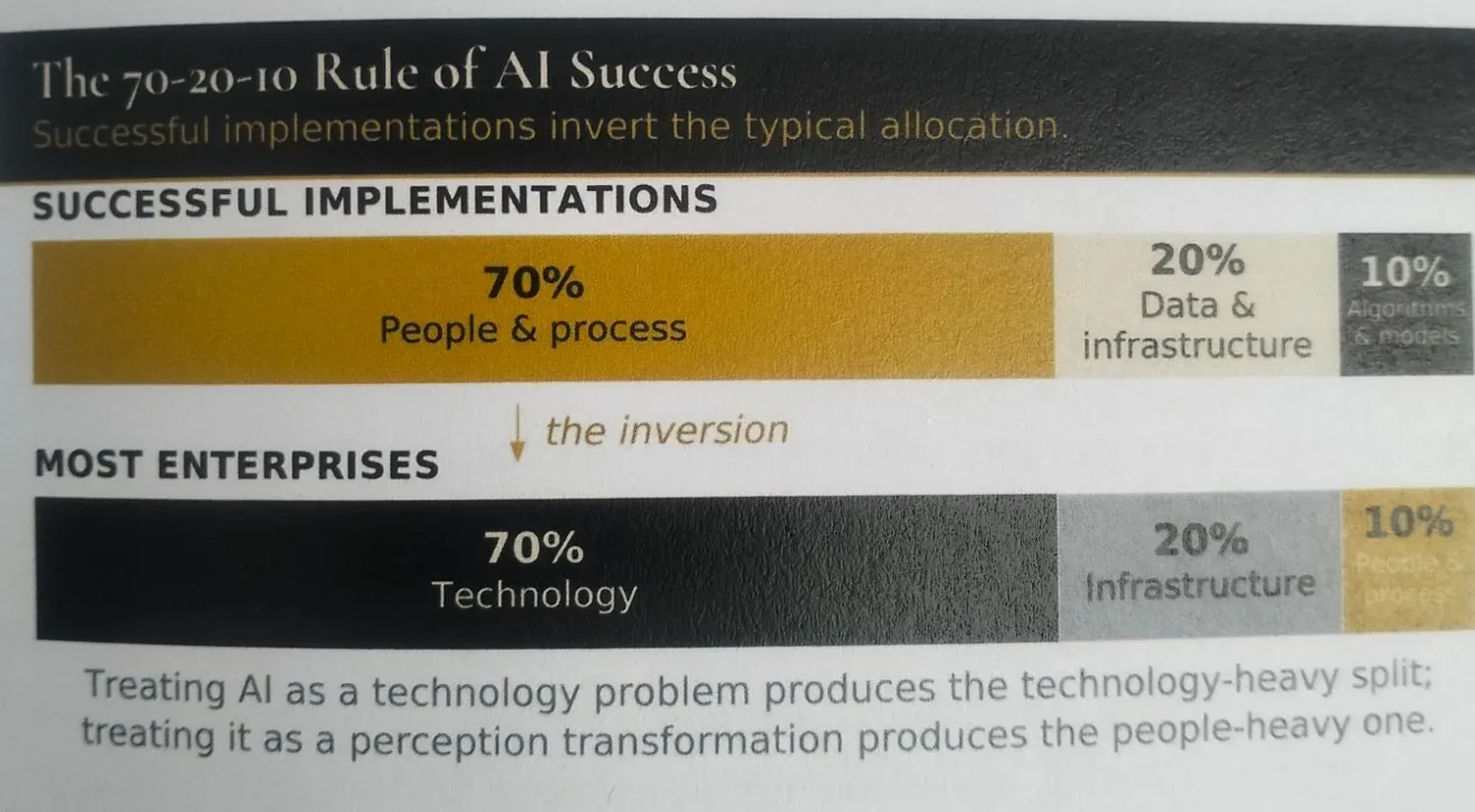
Figure 4.2, “The 70-20-10 Rule of AI Success”, from Perceptive Innovation by Caleb Kow.
Treating AI as a technology problem produces the technology-heavy split. Treating it as a perception transformation produces the people-heavy one — safe spaces for sceptics to voice their concerns, training that addresses identity threat and career anxiety alongside technical skill, process redesign that respects existing mental models before shifting them.
That work is exhausting, expensive, and politically difficult, and it is not what most executives thought they were approving. As Caleb puts it: “They signed up for a technology deployment. They got a perception transformation.”
The ones who recognise the substitution early, and embrace it, are the ones who succeed.
Related posts
Comments
Comments are moderated before they appear.
No comments yet. Be the first.